
Direct answer: Oakville homeowners currently have two Home Renovation Savings pathways that can include attic insulation. The standalone attic offer does not require a home energy assessment and uses a participating insulation contractor. The assessment pathway begins with a registered energy advisor, requires at least two qualifying upgrades and uses different rebate amounts. Confirm the route before any work starts.
The two Ontario attic-insulation rebate routes
The Home Renovation Savings program currently presents a standalone attic-insulation offer and a broader assessment-required offer. Both can apply to an eligible Oakville home, but they are not interchangeable. The required professional, contractor selection, number of upgrades and documentation sequence differ.
Route 1: standalone attic insulation without a home energy assessment
The official standalone page says a home energy assessment is not required. A homeowner first completes the program’s eligibility process. If eligible, the program provides a list of participating insulation contractors. The selected participating contractor helps define the eligible attic work, completes the installation and submits the required application documents.
The program says 100% of the total roof-assembly area must be insulated to qualify. That sentence deserves attention in a home with a main attic, cathedral section, flat roof, addition or separate garage roof. Ask the program and contractor which roof areas are counted, what existing level is recognized and how inaccessible assemblies are treated before signing.
Route 2: assessment-required rebates for two or more upgrades
The second route starts with an initial home energy assessment by a registered energy advisor from an approved service organization. The advisor produces a Renovation Upgrade Report. The homeowner then chooses at least two qualifying measures, has the work completed, and returns to the same advisor for a follow-up assessment. Rebate documents are submitted after that final visit.
This route may suit a homeowner already planning a coordinated project such as attic insulation plus air sealing, windows, a heat-pump water heater, foundation work or another eligible measure. It also adds the time and cost of the assessments, so the correct comparison is the entire project pathway—not only the attic amount.
Attic insulation amounts shown on September 21, 2026
For the standalone attic offer, the official program currently lists these maximum rebates when the upgraded attic reaches at least R-50:
| Starting attic insulation | Minimum after upgrade | Standalone maximum |
|---|---|---|
| R-12 or less | R-50 | $1,250 |
| Greater than R-12 through R-25 | R-50 | $1,000 |
| Greater than R-25 through R-35 | R-50 | $800 |
For the assessment-required route, the official measure list currently shows:
| Starting attic insulation | Minimum after upgrade | Assessment-route rebate |
|---|---|---|
| R-12 or less | R-50 | $1,500 |
| Greater than R-12 through R-25 | R-50 | $1,200 |
| Greater than R-25 through R-35 | R-50 | $900 |
The assessment route also lists a rebate for air sealing tied to the target in the Renovation Upgrade Report. Cathedral ceilings, flat roofs, exposed floors, exterior walls and foundations have separate criteria. These amounts are not a quotation, guaranteed payment or substitute for full program terms. Funding, rules and eligible measures can change.
Who may qualify for the standalone attic offer?
The official page states that the applicant must own the home. Listed housing types include single detached and semi-detached homes, row or townhomes other than stacked townhomes, and mobile homes on a permanent foundation. New-build homes occupied for six months or less do not qualify for the standalone offer.
Heating and utility conditions also apply. The page currently describes eligibility for an Enbridge Gas customer with an active account who primarily heats the home with a natural-gas furnace or boiler, or a home connected to Ontario’s electricity grid and primarily heated with electricity, oil, propane or wood. The official eligibility tool handles exceptions and current details.
Prior rebates, work already started and current enrollment in another Home Renovation Savings route can affect the result. That is why the first step is the official questionnaire, not a contractor deposit. Do not send account numbers or personal details to an unverified rebate website or an unsolicited caller. The official program itself warns about impersonation and fake rebate offers.
The correct sequence for an Oakville rebate project
Standalone attic route
- Open the official standalone attic page and complete its current eligibility process.
- Review the next steps and contractor list supplied by the program.
- Choose a participating insulation contractor through that process.
- Have the attic condition and starting insulation documented before it is covered.
- Approve a written scope that addresses preparation as well as final depth.
- Allow the participating contractor to complete the eligible work and required application.
- Retain the quote, invoice, proof of payment, photographs and program correspondence.
Assessment-required route
- Use the official program process to obtain approved service-organization information.
- Complete the initial home energy assessment before eligible work begins.
- Read the Renovation Upgrade Report and confirm at least two qualifying measures.
- Choose contractors and scopes that meet the report and program requirements.
- Complete the work and keep product, invoice and payment documentation.
- Schedule the follow-up with the same registered energy advisor.
- Keep the final report and monitor the submission through official channels.
The expensive sequencing mistake
Starting insulation before the required eligibility step, participating-contractor selection or initial assessment can make otherwise good work ineligible. Verify the route first. A contractor’s confidence is not a substitute for the program administrator’s written process.
Do not let a rebate target override attic condition
A financial incentive answers whether an eligible measure may receive funding. It does not determine whether existing insulation is dry, whether the roof leaks, whether the bathroom exhaust ends outdoors or whether suspect material is safe to disturb. Those are building-condition questions.
A top-up may be sensible when existing material is clean, dry, stable and compatible. Preparation can include accessible attic air sealing, baffle extensions, hatch improvements, depth markers and localized levelling. Wet or contaminated insulation can require targeted or broader removal after the source is corrected. Vermiculite-like fill, significant mould, animal waste, structural damage or unsafe electrical components require an appropriate specialist boundary.
R-value also does not describe uniformity. A deep measurement beside the hatch can coexist with bare exterior plates, compressed batts beneath storage or a separate addition that was never upgraded. An attic inspection should record multiple zones and limitations before the final layer hides them.
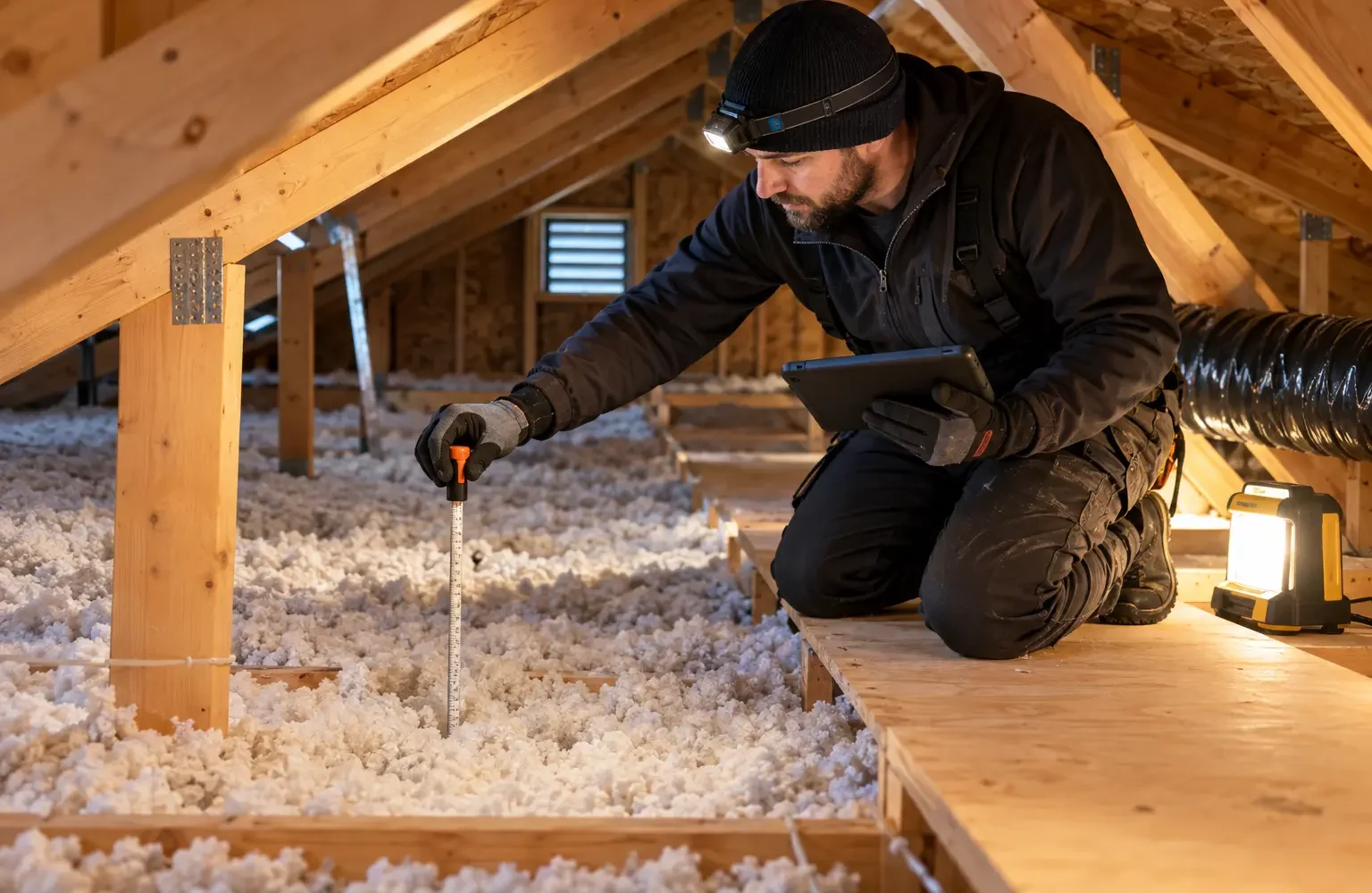
What does “100% of the roof assembly” mean for a complex home?
Ask this question directly through the program when the home has more than a simple open attic. Oakville properties can include additions, flat roofs, cathedral ceilings, dormers, side attics and attached-garage rooms. The official standalone page separately lists cathedral-ceiling and flat-roof thresholds, and it states that the total roof-assembly area must be insulated. Only the administrator can confirm how a specific combination is treated for eligibility.
From a construction perspective, each zone should appear in the quote. If one area cannot be accessed without removing finishes, the contractor should state that limitation. Do not accept a broad “whole attic” description when the roof plan clearly contains several assemblies.
How to compare attic insulation quotes when a rebate is involved
Begin by confirming that each quote is for the same program route and the same roof areas. Then compare the technical scope:
- Starting record: existing material, depth across multiple locations, coverage, moisture evidence and excluded zones.
- Preparation: accessible sealing, baffles, dams, hatch work, exhaust corrections and removal.
- Product: material name or type, intended installed and settled depth, net area and expected coverage.
- Protected details: eaves, chimneys, fixtures, service platforms and mechanical equipment.
- Program work: who confirms eligibility, completes forms and supplies required photographs or invoices.
- Limits: concealed conditions, specialist work, drywall or roof repairs and anything not included.
A lower gross price is not automatically a lower net price if it excludes required preparation or fails to qualify. Conversely, a larger scope is not automatically better if it removes clean insulation without a condition-based reason. Compare the finished assembly and the responsibilities, then consider the expected rebate.
Three common homeowner situations
Situation A: clean, shallow main attic
The attic has dry loose-fill below the intended level, functional exhaust ducts and clear access. A standalone route may be administratively simple if the home and total roof area qualify. The contractor still needs to address eave protection and accessible sealing before the top-up.
Situation B: attic plus another major efficiency upgrade
The homeowner plans attic work and a second eligible measure. The assessment pathway may provide a broader plan and different incentive amounts. The initial assessment must occur before work, and the homeowner should include assessment costs and timing in the comparison.
Situation C: wet insulation after a roof event
The starting R-value may appear to fit a rebate tier, but the immediate priority is tracing the water source, repairing it, removing affected material where necessary and confirming drying. Program questions can be asked in parallel, but the rebate target should not cause damaged material to be buried.
Documents and photographs worth keeping
- Screenshot or PDF of the program route and terms reviewed before work
- Eligibility confirmation and contractor or service-organization list received
- Initial and follow-up energy reports when the assessment route applies
- Signed quote, change orders, invoices and proof of payment
- Starting depth readings and photographs of every accessible roof zone
- Preparation photographs before new insulation conceals the ceiling plane
- Product labels, bag counts or coverage information where provided
- Finished photographs showing depth markers, eaves, hatches and service access
- Program submission confirmations and correspondence
Store these records together. They can help with rebate questions, future roofing or electrical work, warranty conversations and later home ownership.
Official sources to check immediately before work
Use the official standalone attic-insulation page for the no-assessment route. Use the official assessment-required page for the multi-upgrade process and current measure list. Review the program terms linked from those pages. Permit questions about a broader renovation can be checked with the Town of Oakville.
Oakville attic rebate FAQs
Does the standalone attic rebate require a home energy assessment?
No. The official standalone page currently says an assessment is not required. The homeowner must still complete the eligibility process and use the participating-contractor route it provides.
Can I hire any contractor and apply afterward?
Not for the standalone process as currently described. The official page directs eligible homeowners to a supplied list of participating insulation contractors, and that contractor completes the application.
Is the assessment route better because its attic rebate is higher?
Not automatically. It requires an initial assessment, at least two qualifying upgrades and a follow-up assessment. Compare the whole project, costs, timing and improvements you already plan.
Does the program pay for insulation removal?
Do not assume it does. Removal may be necessary for the physical project without being a separately eligible rebate measure. Ask the program administrator and obtain a quote that separates preparation from eligible installation.
Can a contractor guarantee my rebate?
Eligibility and payment are controlled by the program and its current terms. A contractor can document and submit required work within its role but should not replace official confirmation with a guarantee.
Is Oakville Attic Insulation Pros a program-approved contractor?
No program approval, authorization or endorsement is claimed on this website. Use the official eligibility process and the current list it supplies.
Plan the attic before the rebate deadline drives the scope
Confirm the official route, document the starting condition and compare written preparation and coverage—not only the maximum incentive.
Review the rebate resource page