
Incentives, eligibility, contractor lists and funding can change. Confirm your route on the official Home Renovation Savings website before authorizing work or paying a deposit.
Direct answer
Oakville homeowners can currently encounter two Home Renovation Savings paths that include attic insulation: a standalone attic route with no home energy assessment, and an assessment-required route for two or more qualifying upgrades. They use different rebate amounts, contractors and project sequences.
Choose the route first
The program pathway must be clear before work starts
The same physical attic upgrade can be treated differently depending on the selected route. Do not assume that a quote, contractor or assessment that fits one pathway automatically fits the other.
No assessment required
Standalone attic insulation
The official program states that a home energy assessment is not required. Homeowners complete the eligibility process and receive a list of participating insulation contractors. A participating contractor completes the upgrade and application documentation.
To qualify for the attic rebate, the program says 100% of the total area of the roof assembly must be insulated. Starting insulation and the minimum level reached determine the maximum rebate.
Assessment required
Two or more upgrades
This route begins with an initial home energy assessment by a registered energy advisor from an approved service organization. The report identifies recommendations, the homeowner completes at least two qualifying upgrades, and the same advisor completes a follow-up assessment.
Program documents are submitted after the follow-up. The available measure list includes attic insulation, air sealing and other enclosure or equipment upgrades with their own requirements.
Standalone attic amounts
Maximum rebates shown by the official program
| Insulation before upgrade | Minimum level after upgrade | Maximum rebate |
|---|---|---|
| R-12 or less | R-50 | $1,250 |
| Greater than R-12 through R-25 | R-50 | $1,000 |
| Greater than R-25 through R-35 | R-50 | $800 |
These are maximum amounts, not a promise that every attic or every dollar of work qualifies. The official terms, starting condition, total roof-assembly coverage and program process control eligibility. Cathedral ceilings and flat roofs have separate thresholds and amounts on the official page.
Assessment-route amounts
Attic rebates are higher, but at least two qualifying upgrades are required
| Insulation before upgrade | Minimum level after upgrade | Listed rebate |
|---|---|---|
| R-12 or less | R-50 | $1,500 |
| Greater than R-12 through R-25 | R-50 | $1,200 |
| Greater than R-25 through R-35 | R-50 | $900 |
The official assessment route also lists an air-sealing rebate tied to the target in the Renovation Upgrade Report, plus separate requirements for cathedral or flat-roof insulation, exposed floors, exterior walls, foundations and other measures. The energy advisor’s report and current program terms determine what can be included.
Required sequence
Protect eligibility by completing each step in order
Standalone route
- Use the official eligibility form before starting attic work.
- Receive and select from the participating-contractor list.
- Have the participating contractor complete the eligible insulation.
- The contractor submits the required application documents.
- The program processes the rebate if the application qualifies.
Assessment route
- Complete the official eligibility process.
- Schedule the initial assessment before beginning eligible upgrades.
- Review the Renovation Upgrade Report and choose at least two qualifying upgrades.
- Complete the work and keep invoices and project records.
- Complete the follow-up assessment with the same registered energy advisor.
- Wait for the advisor’s submission and program processing.
General eligibility
Who the standalone page currently says may qualify
The program states that the applicant must own the home. Eligible housing types include single detached and semi-detached homes, row or townhomes other than stacked townhomes, and mobile homes on a permanent foundation. New-build homes occupied for six months or less do not qualify for this offer.
Heating and utility conditions also apply. The official page describes eligibility for qualifying Enbridge Gas customers who primarily heat with an Enbridge natural-gas furnace or boiler, or homes connected to Ontario’s electricity grid and primarily heated with electricity, oil, propane or wood. Full terms and location-specific exceptions must be checked in the official tool.
Attic suitability
A rebate target does not override the physical condition
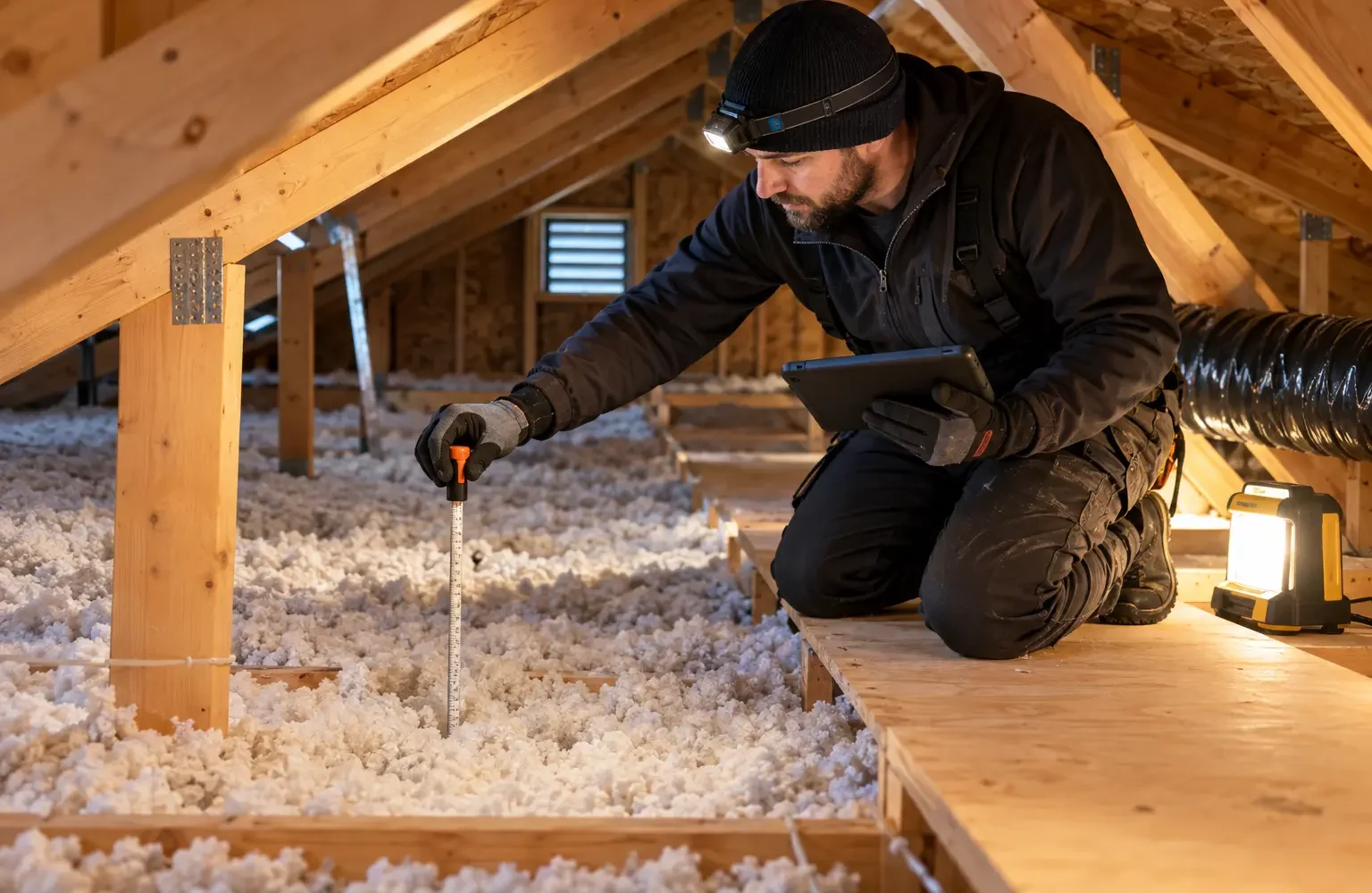
Program eligibility answers a funding question. It does not prove that the attic is ready for a top-up. Active roof leakage, significant condensation, disconnected exhausts, unsafe wiring, suspect vermiculite, mould, pest contamination or damaged material may require repair, specialist assessment or removal before ordinary installation.
The starting level should be documented across multiple zones. An easy measurement beside the hatch may not reflect low eaves, additions or disturbed areas. If 100% roof-assembly coverage is required, clarify how cathedral ceilings, flat roofs or inaccessible sections are treated by the current program before committing to a scope.
Preparation can include accessible air sealing, baffle and dam work, hatch improvement and localized removal. Confirm which preparation costs or measures qualify. An item that improves the project can still fall outside a rebate calculation.
Documents to retain
Create a project record that supports both quality review and the application
- Eligibility confirmation and the program route selected
- Initial energy assessment and Renovation Upgrade Report, when required
- The participating-contractor or approved-service-organization information provided by the program
- Written quote showing included roof areas, preparation, material and target
- Starting-condition photographs and depth records from multiple locations
- Invoices, proof of payment, product information and completion photographs
- Follow-up assessment and program correspondence, when applicable
Keep program communications in the same project folder as the contractor scope. If a requirement changes or an area is excluded, written records make it easier to ask the program administrator the right question before work continues.
Official sources
Verify the current rules where the application is administered
Standalone attic-insulation rebate details ↗
Assessment-required upgrades ↗
Rebate FAQs
Questions to settle before signing
Does the standalone attic rebate require a home energy assessment?
The official standalone attic page currently says no. It uses its own eligibility and participating-contractor process.
Can any insulation contractor complete the standalone work?
The official process directs eligible homeowners to choose from a participating insulation contractor list supplied after eligibility is confirmed.
Can work start before an assessment in the two-upgrade route?
The program sequence currently requires the initial home energy assessment before eligible upgrades begin.
Does reaching R-50 guarantee the rebate?
No. Starting level, eligible housing and heating, roof-assembly coverage, contractor or assessment route, documentation and full program terms all apply.
Is Oakville Attic Insulation Pros approved by the program?
No approval, authorization or endorsement is claimed on this website. Homeowners should use the official eligibility process and the current contractor or service-organization lists supplied by the program.
No program-approval claim
Oakville Attic Insulation Pros does not claim to be approved, authorized or endorsed by the Town of Oakville, Enbridge Gas, Save on Energy, the IESO or the Ontario government. Use the official program process and its current lists whenever participation requires them.